Lesson 1: Electromagnetic Radiation

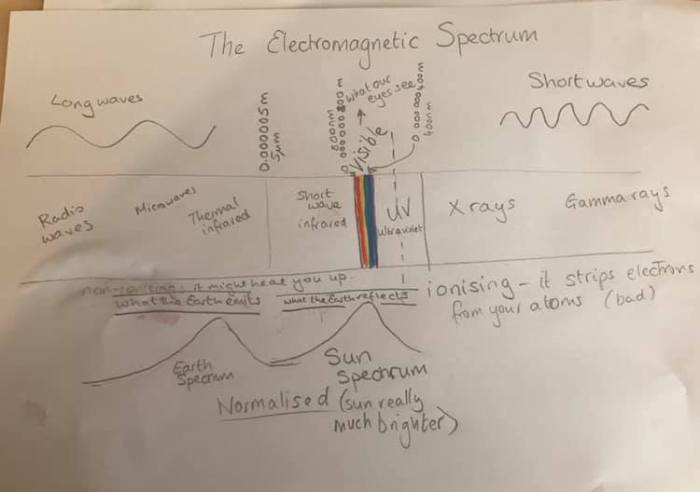
EM Spectrum image

To understand climate change, we first need to understand light. (Personal aside: I got a prism for my tenth birthday and told everyone that one day I’d get a job splitting light into pretty colours – so of course I start here)

Light is electromagnetic waves that travel at the “speed of light”. The properties of light depend on the wavelength (how many times the electromagnetic field vibrates). Short wavelength light vibrates lots and the wavelength is small enough to get inside you and damage you – that’s “ionising radiation”: ultraviolet that damages your skin and x-rays and gamma rays that go inside.

Long wavelength light is radio and microwaves and the infrared. That can’t damage your molecules directly, but (and we’ll come back to this), some infrared and microwaves can make molecules vibrate which heats things up.

In the middle is visible light – the bit we can see. At 400 nm (nanometre – that means 0.000 000 400 m) wavelength we start to see blue light (if we don’t have cataracts) around 555 nm it looks quite green – and our eyes are most sensitive. At 800 nm we just about see a deep red (unless colour-blind and lacking red sensors).

Now it’s no coincidence that this is the bit of the electromagnetic spectrum that we see best. This is the peak of the sun’s spectrum – and all we see on Earth is visible electromagnetic radiation from the sun (or one of our artificial lights) that reflects from the Earth.

But the Earth itself does glow – just in wavelengths we don’t see. We call that the thermal infrared. In lesson two I’ll explain about blackbody radiation.
Climate Lessons Introduction

This is my personal blog. I’ve been using it for a few years to post my thoughts. At first it was a place where I explored my thoughts about topics that were controversial – particularly those that people argued about on Facebook. I also explored my faith and how I connected my science to my faith.

However, recently, I started writing “lessons on climate change” on Facebook. I did so because I wanted to help my friends understand some of the basic principles of climate science. I soon realised Facebook was not the best place for such lessons, so I moved them here. Because the blog still has some more personal posts, I’ve left this anonymous. I may change that later – but I’m guessing most of my readers know exactly who I am.

I’ve now posted quite a few climate blogs – so I’ve created a page to help you find them easily.

Not trusting experts

Probably the defining quote of the Brexit campaign was when Michael Gove said “Britain has had enough of experts.” That sentence either swung the poll in itself or was an incredibly astute observation from someone whose political reputation at that point was disastrous. It showed up the main difference between how Remain campaigned and how Leave campaigned. 

The university-educated middle classes, especially those in the “London-bubble” and who tended to vote Remain and made up the majority of the Remain campaigners, were using the kinds of arguments that convinced them: apparently rational arguments based on the views of economic (and other) experts. The campaigners spoke to different expert groups in turn and produced clear predictions of the difficulties: economic, legal, practical. The people who listened were themselves experts and they were convinced by other experts. 

The Leave campaign focused on more emotional arguments – appealing to national pride, fear of immigrants, the desire to “take back control”. It’s becoming increasingly clear that they didn’t have thought-through expert plans on what these ideas mean. 

Now, while I was (and am) staunchly pro-EU, the point of this blog is not to discuss those arguments. It is to consider why “Britain has had enough of experts” was so successful.

I think there are two reasons. The first is a sense of anger from a large part of the community who feels unheard, ignored and arrogantly patronised by the “elites”.  There is an isolation between London and the regions, between the wealthy and the poor. And this isolation has increased over recent years and while neither side really understands the lifestyle, challenges and pressures of the other, the power balance is very uneven. 

During the Brexit campaigning I joined a group on Facebook called “Scientists for the EU”. When anyone came on that forum and said anything pro Leave, the response (early on – the moderators stopped this eventually) was a barrage of insults about their lack of education, which amounted to “your opinion is worthless if you don’t have a PhD”. The arrogance and rudeness was awful. It’s hardly surprising that people wanted to annoy people who had treated them with such disdain by doing the opposite of what they said. 

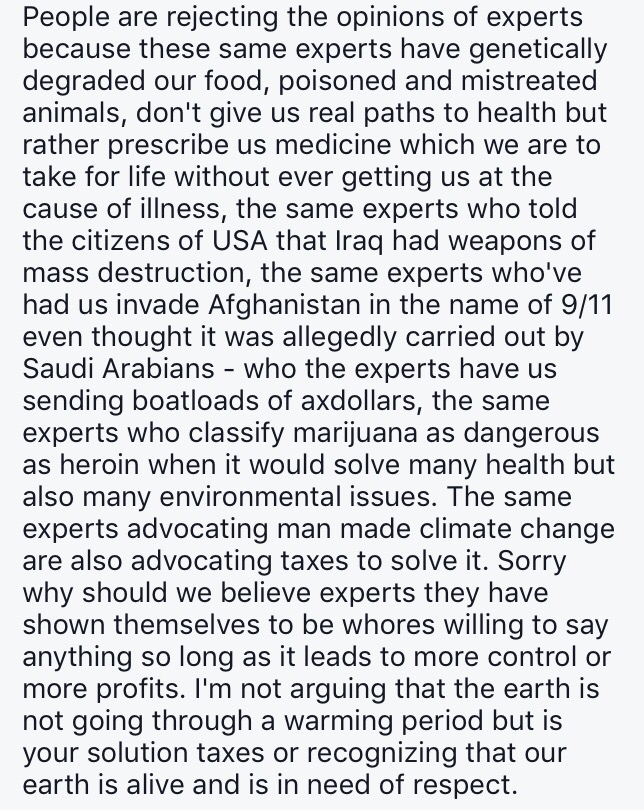
That alone couldn’t fully explain the success of the slogan, though. Recently I understood a bigger reason. I was debating climate change on Facebook and I asked someone why she didn’t trust experts. This was her reply:


Another person expanded on this. They have noticed that Al Gore, who in the USA at least is the face of saying climate change is real, is a politician whose political views they disagreed with, and who now owns shares in carbon trading companies, so he will make a personal fortune if carbon trading is fully introduced. 

And without having distinguished scientific truth from other types of truth (see earlier blogs), because they disagree with (and are suspicious of) his suggested solution to climate change, they also don’t trust him saying climate change is real.