Lesson 2: Blackbody radiation

blackbody radiation

One of the most important bits of physics to understand, before we get to climate, is what blackbody radiation is all about. So this builds on lesson 1 about the electromagnetic spectrum. Here I’ve zoomed in on the middle bit and turned the scale around (so now IR – long wavelengths – are on the right and UV – short wavelengths – are on the left).

When something is perfectly black, it will absorb all energy falling on it (nothing is reflected) but if that were the whole story, things would get hotter and hotter for ever. Of course, that does not happen – because black bodies also radiate energy away as “light”. The blackbody curve (see picture) shows how black objects radiate “light” – and what wavelengths of electromagnetic radiation are radiated. That depends on how hot the object is.  Max Planck wrote down the theory of the blackbody curve back in 1900 and, almost by accident, invented quantum mechanics in the process (but let’s not get side tracked down that interesting alleyway).

As a blackbody gets hotter it emits more light and the spectrum shifts “up and left” (so more light, and the peak moves to shorter wavelengths).

Now that’s all a bit physicy and esoteric so let me link it to things you already know. You already know the idea of “red hot” – as you start heating an electric stove and it gets hotter there comes a point where it starts to glow red. What has happened is that the curve has shifted up and left enough that there’s enough red for you to see it. That’s somewhere around 600 degC (scientists call this ~900 kelvin as we like to start temperatures at absolute zero).

If you keep heating something up it will go orange hot as you start getting orange and red wavelengths too. Your old fashioned tungsten lightbulb (I hope by now replaced by an LED!) had a tungsten filament at around 2500 K – 3000 K (subtract 273.15 to convert to degrees Celsius). That was a yellowy-white. The outside of the sun is about 5500 K and that is “white hot” – the peak of the blackbody curve is in the middle of the visible so all the wavelengths are there and they mix to look “white” (remember Newton splitting white light with a prism to show all the wavelengths are there). There are stars hotter than our sun that are “blue hot” as their peak is in the UV and their spectrum is already dropping in the visible – with blue much higher than red.

But you can see from the graph that the sun also emits plenty of what we call “short wave infrared” (incidentally that was the problem with tungsten lamps – almost all their radiation was actually infrared and thus invisible.).

Of course it doesn’t stop there. Almost everything has a blackbody curve. Blackbodies around room temperature (~300 K) have a peak at wavelengths around 10 micrometres. That’s a wavelength we call “the thermal infrared” and it’s what those thermal imaging cameras you see in science museums (the ones that give people red faces and blue noses and black glasses) measure. Even space itself has a microwave blackbody signal – that represents a temperature of around 3 K (just above absolute zero) – and is the temperature the Big Bang has cooled down to.

Now real objects aren’t perfect blackbodies – they reflect some light – but these basic ideas hold up. And the sun and earth are, to a first approximation, blackbodies at 6000 K and 300 K respectively. And this matters because it’s how the sun heats the Earth up and how the Earth cools back down again.

(Don’t worry, we’ll start getting onto the climate soon! This is the background stuff that makes the explanation meaningful. I know this stuff is hard, so please feel free to ask questions. Lesson three will involve my favourite equation and how atoms and molecules emit and absorb single wavelengths of light rather than blackbodies emitting and absorbing broad spectra … and then we’ll start talking about the temperature of the Earth!).
Lesson 1: Electromagnetic Radiation

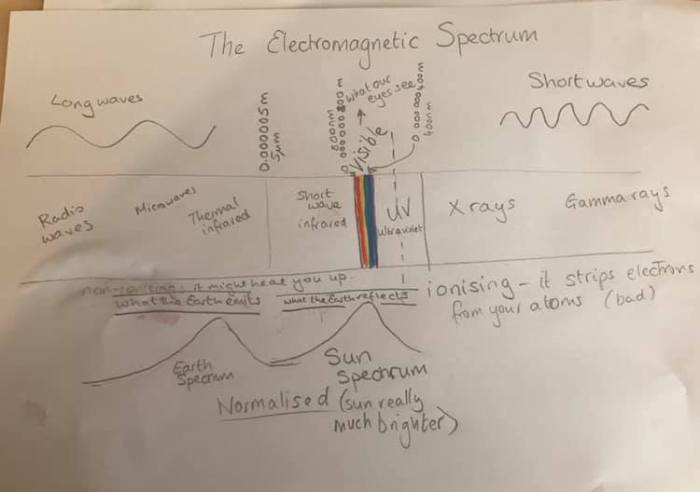
EM Spectrum image

To understand climate change, we first need to understand light. (Personal aside: I got a prism for my tenth birthday and told everyone that one day I’d get a job splitting light into pretty colours – so of course I start here)

Light is electromagnetic waves that travel at the “speed of light”. The properties of light depend on the wavelength (how many times the electromagnetic field vibrates). Short wavelength light vibrates lots and the wavelength is small enough to get inside you and damage you – that’s “ionising radiation”: ultraviolet that damages your skin and x-rays and gamma rays that go inside.

Long wavelength light is radio and microwaves and the infrared. That can’t damage your molecules directly, but (and we’ll come back to this), some infrared and microwaves can make molecules vibrate which heats things up.

In the middle is visible light – the bit we can see. At 400 nm (nanometre – that means 0.000 000 400 m) wavelength we start to see blue light (if we don’t have cataracts) around 555 nm it looks quite green – and our eyes are most sensitive. At 800 nm we just about see a deep red (unless colour-blind and lacking red sensors).

Now it’s no coincidence that this is the bit of the electromagnetic spectrum that we see best. This is the peak of the sun’s spectrum – and all we see on Earth is visible electromagnetic radiation from the sun (or one of our artificial lights) that reflects from the Earth.

But the Earth itself does glow – just in wavelengths we don’t see. We call that the thermal infrared. In lesson two I’ll explain about blackbody radiation.

Resonance

This is something I wrote some time ago that describes why I use the analogy of resonance to explain what I feel in my faith when I am aware of God. 

Part 1: Physics
In physics the term resonance refers to the phenomenon where a free body will vibrate in response to an external frequency. It is what causes a hanging bell to start to ring if you sing its note – and it’s what causes a wine glass to crack to a soprano’s singing. The resonance of atoms in a laser gets light to be emitted in sync, in phase – so the laser beam is amplified and coherent. A swinging pendulum in resonance with a vibration will start to swing every larger swings.
In all these examples the body in resonance simply responds. And when it is in full resonance it has energy far bigger than it had in isolation – the pendulum swing grows, the grass cracks, the bell rings loudly.
A body can be in partial resonance too – when its frequency (note) doesn’t quite match the forcing tune. If the body is free it can come into resonance – the pendulum swing will change to match.

A body can’t be in resonance if it is touching others – glasses pushed against each other will hit each other and sound “clashing” rather than ringing a note. Atoms in a lightbulb filament emit white light (mixed “clashing” frequencies) rather than the pure colour of a laser beam.
Part 2: Explaining the analogy

An analogy that means a lot to me is the analogy that “walking in the Light” means a heart, mind and soul in resonance with God. When we are in full resonance, we respond to God. We are “in tune” with God, we are in sync with God.

In this state our response is natural, we actually can’t help obeying God – God’s Will becomes our only option. The things we struggle with when we are out of resonance: “how do I be still?” “How do I find God?” “How do I know what is God’s Will and what are my own notions?” These questions – once so urgent – become irrelevant as the answer is obvious.

“How do I resist temptation?” is no longer a question of will power, because there is no will power. We simply respond the only way a body in resonance can – we sing God’s tune.
We don’t fall immediately into resonance – we approach it, our swing gets closer to God’s. As we approach resonance we start to feel it, to sense ourselves going into the flow of Life Abundant. Our sense of strength, our ability to act, our ability to love grows – and the more we let go into resonance, the stronger the power of God acts through us – we feel that power, that energy, that overwhelming outpouring of Love. 

It is not the frenetic energy of our own adrenalin rush, it is a calm energy – an energy where time, our physical health or our limited skills don’t matter because it is not us who is acting, but God acting through us. God directs us, draws us closer.

In full resonance we cannot easily be knocked by the outside world. Our hearing of God’s tune is so much stronger than what the world throws at us.

We can, however, lose resonance. And the physics analogy works here too – we lose resonance if we become stiff (or too floppy) – if we don’t let go into the song, (or lose our integrity and wholeness). If we resist God’s tune, the resonance is dampened and we do feel that dampening – we lose the energy we had, we lose the sense of easy connection, we start to ask the questions again: how do I find God? How do I know what is of God and what is of me? How do I hear God’s Will? 

Sometimes the loss of resonance is internal – our own stiffening; sometimes it is external. Like the glasses pushed together, we can no longer sing our tune with God because we are jostled, hit into by other people’s agendas, constrained by worldly commitments. We may be knocked out of resonance by an external blow or simply slip away because we let our attention drift away.

To get back into resonance we simply need to hear the Song. We need to let go and be vulnerable and weak so we are free to move in response, not stiff from our own notions. We need to separate ourselves – slightly – from the people who stop us responding, a separation that also leaves them to respond themselves. In physics, “loosely coupled oscillators” get into sync with each other and the main beat naturally – we need some connection with other people, but not so much that we are dependent on them.

Finally, we can consider a gathered Friends’ Meeting for Worship as one in which everyone has reached resonance with God, the driving force. That resonance naturally means that we also reach resonance with one another and that energy (here – Love) flows between the different people so that we remain individual, but respond together. 

I feel spiritual resonance with God physically and in a gathered Meeting for Worship I can feel the flow of Love between people. 

Different types of truth part 1: Scientific truth

What is truth? This is a question for philosophy, science and religion, or rather these words provide different questions to philosophy, science and religion. I feel that one thing that is missing from many arguments is a clear understanding of what is, and what isn’t possible to argue about. 

There is a difference between arguing about whether greenhouse gases cause a warning planet, about whether solar cycle effects are increasing or decreasing that warming, about what we should do about it. There’s a difference between arguing about whether God exists, or whether a homosexual can be a Christian, or whether gun restrictions should be introduced. And these differences are because they are asking for a different kind of truth. 

 I know people who enjoy philosophy and will ask questions about whether mathematics is discovered or invented, about whether “2+2=4” is fundamentally true or axiomatic, about whether there is anything true except “I think therefore I am”. I am not writing this blog for those people. Their definition of “truth” is very narrow and will not encompass scientific truth. That the Earth goes round the sun is, for them a “theory”. If we argue at this level it will take us too long to understand the difference between the questions “what causes climate change?” and “what shall we do about it?”. I am a scientist, not a philosopher and while I acknowledge the questions exist, I do not propose to discuss them further here. And there is a reason for this. If you hear those arguments without having heard their context you will get confused. I think this is part of what leads to arguments about the “theory of evolution” or the “greenhouse effect theory”. 

Consider gravitational theory (Newton’s and Einstein’s). This is not true in the sense that 2+2=4, or in the sense that “this blog’s name is scientificquaker”. But it is effectively true. We can use it to make predictions, it is tested to the limits of our experimental and observational capability, we have underpinning theoretical explanations of “how it works” which can, themselves, make predictions we can test. 

I have heard it said that “Einstein proved Newton wrong” and this used as an argument for why scientists may also be wrong on climate change. But Einstein didn’t prove Newton wrong – and we still use Newtonian mechanics to launch a rocket. But we use Einsteinian mechanics to consider the workings of the clocks in the GPS satellites. What we must understand is that both Newtonian and Einsteinian mechanics are our models which explain, as far as they can, the physical workings of the universe. They aren’t the workings of the universe but they are models which help us understand what we otherwise can’t understand. We also know – because we’ve tested it – how far those models can go and where we don’t know. Einstein’s theory includes Newton’s theory. It didn’t correct it, but extended it to where it didn’t apply. Most of the time Newton’s theory works well and when it doesn’t we can use Einstein’s extension. We also know how deeply we’ve tested Einstein’s theory (and we continue to probe beyond those borders (http://m.phys.org/news/2016-04-einstein-theory-relativity-satellite.html).

Scientific truth therefore is something where we have a working model that has an underlying theoretical basis (we can explain why), is backed by observation/experiment and which makes meaningful predictions we can test by observation/experiment. We generally expect scientific truth to expand with time, that the new theory encompasses the old and expands its remit or the level of detail. It is rare for a new theory to contradict an old one. 

It is not that individual scientists aren’t biased, don’t make mistakes, but when there is scientific consensus, the ideas have been thoroughly tested. (I am talking about the physical sciences here – what I know about – I think some aspects of biological science and many aspects of social science need a more nuanced argument). 

When there isn’t scientific consensus we realise there are aspects we don’t understand. Those different viewpoints are helping us explore different aspects. Scientists may debate for years, even decades, but there is a recognition that we are all chasing a single, as yet unknown truth. Most scientists know when we haven’t and when we have reached it, though being human can be upset when their way of understanding is superseded. Some discussions are debated for thirty years – until the last generation has retired off…

Maybe it’s because such debates look, from the outside, so similar to debates about whether God exists or whether socialism or capitalism is better for society (blogs to come!) that nonscientists don’t understand the difference. 

There’s a t-shirt slogan that says “the nice thing about science is that it’s true whether or not you believe in it”. Scientists love it – and it tries to express what I’ve discussed here, which scientists find baffling to understand why everyone else doesn’t get this intuitively. They often go on to assume it’s because everyone else is stupid. And that’s why I don’t like the slogan.